

For firms across the Wealth and Asset Management ecosystem, technology decisions are no longer as straightforward as choosing whether to build a capability in-house or buy it from a vendor. AI is evolving rapidly, cloud platforms continue to mature, regulatory expectations are increasing, and modern client experiences depend on multiple systems working together. As a result, the right answer is often not simply build, buy or partner but it is knowing when to combine all three.
Technology changes too quickly for static decisions
Building technology in-house gives firms greater control. They own the code, the roadmap, the data model and the intellectual property. For capabilities that create real competitive advantage such as proprietary investment models, client intelligence or unique adviser workflows, that level of ownership can make sense.
But control also comes with long-term responsibility. Firms must maintain the platform, manage security, update integrations, keep pace with regulation and attract the specialist talent needed to support it.
With AI evolving so quickly, that challenge has become even greater. The challenge is rarely access to new technology. It is connecting that technology to existing data, controls and business processes. A custom-built solution may look modern on launch day, but without continuous investment it can quickly become tomorrow's technical debt.
The cost of building extends beyond development
Building in-house is often justified by comparing development costs with the price of an annual software license. In reality, the decision is far more complex. The true cost of building includes product design, engineering, cloud infrastructure, data migration, security, compliance, testing, ongoing maintenance, upgrades and retaining the specialist talent needed to support it. Just as important is the opportunity cost. Every engineer, architect and data specialist working on an internal platform is time not spent on initiatives that could create greater competitive advantage. Time also matters.
A complex in-house capability can take 18 to 30 months to reach broad production use. A packaged platform may reduce that to 6 to 12 months, while an experienced technology and delivery partner can sometimes deliver an initial production release in 4 to 9 months. These are planning ranges rather than fixed benchmarks, but they highlight an important point: time to value should be part of every technology decision.
Buying is faster, but not automatically simpler
Buying a mature platform can reduce development risk, especially for capabilities that are essential but not a source of competitive advantage, such as CRM infrastructure, identity management, communication archiving or standard workflows. Firms benefit from proven functionality, regular updates and a roadmap shaped by investment across many clients. But buying the platform is only the beginning. It still needs to integrate with client and portfolio data, existing systems, compliance controls and day-to-day workflows. In many cases, internal processes and data also need to evolve.
A platform may be live, but if advisers continue relying on spreadsheets or manual workarounds, the business value never fully materialises. That is why software selection should always be considered alongside implementation, integration and change management.
Platform economics favour reuse
Technology becomes more valuable when firms reuse what they have already built instead of recreating the same capabilities for every new initiative. A strong platform can provide shared identity, permissions, data access, workflows, analytics and governance across multiple use cases. As those foundations are established, each new capability becomes faster and more cost-effective to deliver.
This is especially important in Wealth and Asset Management, where client engagement spans research, adviser preparation, campaigns, reporting and digital experiences. Building each capability from scratch or buying a collection of disconnected applications, often leads to duplicated controls, fragmented data and inconsistent experiences.
A more sustainable approach is to buy mature infrastructure, build only the capabilities that create competitive advantage, connect everything through governed APIs and partner where specialist delivery expertise adds the greatest value. PwC estimates that financial industry firms are moving quickly with technology-as-a-service models.
potential revenue uplift by 2028 for Asset and Wealth Managers moving quickly to adopt tech-as-a-service models.
Source: PwC, 2024 Asset & Wealth Management Report

Partnership changes the delivery model
A partnership is about more than combining software with consulting services. At its best, it creates shared responsibility for delivering a successful outcome. The institution provides strategic direction and retains regulatory accountability. Technology partners contribute proven platforms, while implementation and consulting partners help integrate those capabilities into the business. Compliance and specialist providers ensure governance is built in from the start. This model is becoming increasingly important because technology no longer succeeds in isolation. Delivering meaningful change requires expertise across platforms, operations, regulation and adoption.
Speed to market depends on readiness
Partnering can accelerate delivery, but speed depends as much on institutional readiness as it does on technology. Unclear ownership, unresolved data issues, inconsistent security requirements, late compliance involvement and excessive customisation can quickly slow implementation.
Before selecting a delivery model, firms should align on the problem they are solving, the minimum useful outcome, the data and systems required, the regulatory and security boundaries, and the measures that will determine success.
With those foundations in place, a focused pilot can test not only the technology, but also the operating model, governance and ability to scale.
Regulation makes partnership governance essential
Who owns, accesses and deletes the data?
Which controls and testing standards apply?
How quickly can service be recovered?
Which additional providers are involved?
What evidence can the institution obain?
Who approves material updates?How will data and services be transferred?
Build carries risk too. A proprietary system may depend on a small number of employees, undocumented code or unsupported infrastructure. Internal ownership does not automatically mean lower concentration risk.
A practical decision framework
Build when
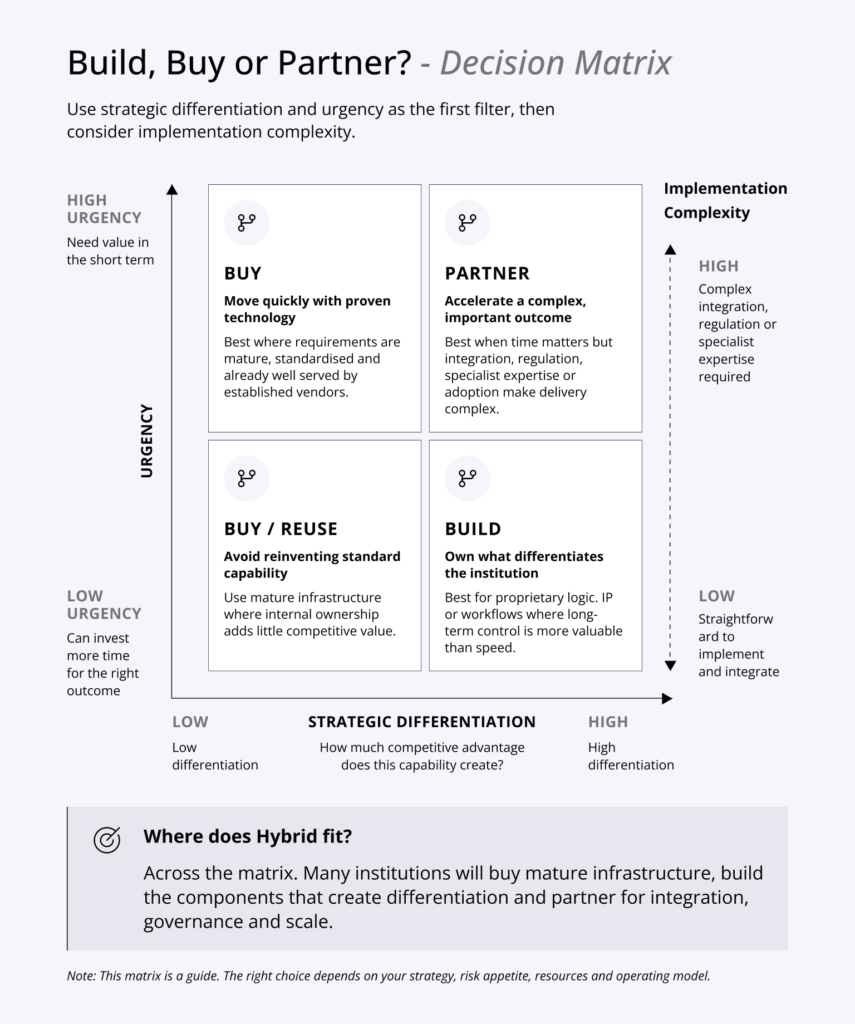
Build when the capability creates clear competitive differentiation and proprietary logic or intellectual property is central to the firm’s advantage. This approach is strongest when the institution has sustainable product and engineering capacity, values control over speed to market, and expects the capability to remain strategically important over the long term.
Buy when
Buy when the requirement is mature and standardised, and established vendors can already meet most of the institution’s needs. It is particularly appropriate when integration requirements are manageable, the vendor roadmap aligns with the firm’s direction, and internal ownership would provide limited competitive advantage.
Partner when
Partner when the desired outcome spans multiple systems or teams and requires specialist industry, technology or regulatory expertise. Partnership becomes particularly valuable when time to value matters, internal specialist resources are constrained, and successful delivery depends on integration, adoption and continuous improvement.
Use a hybrid model when
A hybrid model works well when some capabilities create genuine differentiation while others do not. It allows firms to retain control over proprietary data, intelligence or workflows while relying on proven technology and specialist partners elsewhere. This can be particularly effective when multiple capabilities need to operate as one ecosystem while the underlying architecture remains modular and adaptable.
The decision is about capability, not ownership
Building can create competitive advantage. Buying can provide faster access to proven technology. Partnering brings the specialist expertise needed to implement, integrate and scale it successfully. The strongest technology strategies combine all three: build where ownership creates real differentiation, buy where mature solutions already exist, and partner where success depends on integration, governance and adoption.
Subscribe to our newsletter
A monthly or so newsletter that sums up all our news, tips, insights and observations from the world of sales engagement in the wealth management eco-system.