
A strong brand, a broad product shelf, investment expertise and access to opportunities could distinguish one institution from another. Although these capabilities still matter, they are becoming more widely available and therefore less reliable as standalone sources of advantage. Products can be replicated, research is widely available, and clients have more choice than ever through open architecture.
With digital investing tools now commonplace, the gap between institutions on core portfolio services has narrowed considerably. That is why client engagement is moving from a broad service ambition to a measurable commercial discipline.
It's becoming harder for Private Banks to stand out on products alone
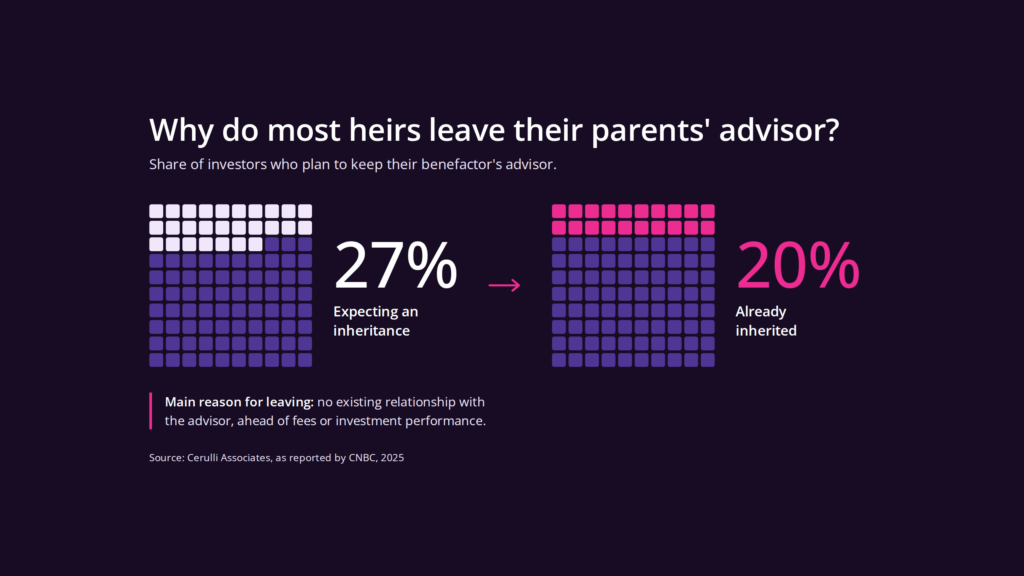
The growth of global wealth creates significant opportunities for Private Banks. BCG estimated that global financial wealth reached US$305 trillion in 2024, supported by an 8.1% rise in financial assets. But it also argues that market performance alone will not determine which Wealth Managers grow. Organic growth, retention and the ability to win a greater share of existing client assets are becoming more important.
EY’s 2026 wealth research found that wealthy clients now use an average of 2.3 wealth managers.
of wealthy clients expect to move between 25% and 50% of their assets over the next three years.
Source: EY, Global Wealth Research Report 2026

These figures point to a market in which relationships are becoming more fluid. Clients may still value their primary adviser, but they are willing to maintain several relationships, self-direct part of their wealth or move assets when another provider offers clearer value. A bank cannot rely solely on the strength of its investment proposition, but must continually demonstrate why it deserves the client’s attention, confidence and assets.
Expertise only makes a difference when it's put in front of clients
Private Banks often speak about trust as an enduring quality of the relationship. Clients, however, judge it differently. They judge it through the consistency of advice, the quality of communication and whether their adviser delivers when it matters most. For example:
Turn content into meaningful engagement
Create, distribute and measure content that helps advisers deliver more relevant client experiences.
Consistency is the real challenge
Content is usually spread across multiple systems. Research may be too technical to share directly, approved materials can be difficult to find, different teams manage different channels, and engagement data is not always accessible to relationship managers.
As a result, client communication often depends on individual effort. One relationship manager may distill a CIO report into a personalised message, another may forward the full PDF, while a third may not share it at all because the process is too time-consuming. McKinsey suggests that up to 80% of new Wealth Management clients expect advice that is increasingly data-driven, personalised and continuous, rather than limited to periodic meetings. It is thus paramount to communicate at the right time, with the right insight, in a way that is relevant to the client.
More communication is not the answer
The abundance of financial content creates another problem: attention is becoming scarcer. Clients already receive news alerts, research, newsletters, product updates and market commentary from several institutions. Increasing communication volume without improving relevance may weaken engagement rather than strengthen it.
The objective should not be to distribute everything to everyone, but instead understand which insight matters to How it should be presented? When is it most useful? Which adviser or channel should deliver it? What conversation is it intended to support?
This requires a different operating model. Research needs to be easy to adapt across formats, relationship managers need quick access to approved content, and communication should reflect each client's interests and preferences. Institutions also need to understand how clients engage with the content they receive.
Avaloq's 2025 research found that 69% of investors wanted advisers to respond more quickly to market changes, while 38% of wealth professionals said they lacked the time to deliver personalised advice. The challenge is clear: clients expect greater relevance and responsiveness, while advisers face increasing capacity constraints.
Engagement becomes more valuable when it can be measured
Historically, many wealth managers have had limited visibility into what happens after a communication is sent. An email may be opened, a report downloaded or an event attended, but these metrics reveal only part of the picture. Modern engagement platforms allow firms to see which investment themes resonate, which formats clients engage with, and whether content leads to conversations, meetings or new opportunities.
For marketers, the data highlights what clients respond to, whilst for relationship managers, it can reveal the right moment to get back in touch.

Dominic Gamble
CEO and Co-founder, Upscale
Scaling engagement responsibly
Stronger engagement cannot come at the expense of supervision, privacy or regulatory compliance.
AI-generated and digitally distributed communications remain subject to the same standards. As FINRA has made clear, firms are responsible for supervision, recordkeeping, accuracy and compliance.
Good governance doesn't slow communication down but makes it possible to scale with confidence. Approved content, human oversight and audit trails help firms move faster while maintaining the standards expected by clients and regulators.
The future is measurable client engagement
As products become easier to replicate and information more widely available, the quality of client engagement will become an increasingly important differentiator.
Private Banks that connect institutional expertise with advisers, communication channels and client insights will be better placed to build stronger relationships over time.
In a market where products can be matched and information is widely accessible, the ability to deliver timely, relevant and measurable engagement may become one of the few competitive advantages that is difficult to replicate.
Subscribe to our newsletter
A monthly or so newsletter that sums up all our news, tips, insights and observations from the world of sales engagement in the wealth management eco-system.