

Upscale - AI-powered engagement platform
Get in touch
INSIGHTS

What does the great wealth transfer mean for client communication?

Date:

12 October 2026

Category:

Independent Wealth Managers
Go Upscale Favicon

Upscale Team

Share this post:

How much wealth is moving to the next generation?

Cerulli Associates' 2024 research projects that US$124 trillion in assets will pass from older generations to heirs and charities by 2048. US$105 trillion will go directly to heirs, beginning with spouses in the baby boomer generation who account for around 81% of that total. Thereafter, Millennials stand to inherit more than any other generation, an estimated US$46 trillion over the next 25 years.

The figure is so large that it is treated as an abstraction or a headline number with nothing to anchor it against. That is because the transfer does not arrive as a single event on a single date. It unfolds household by household, often at a moment of loss, and to people the institution’s advisor has never met.

It unfolds household by household, often at a moment of loss, and to people the institution's advisor has never met.

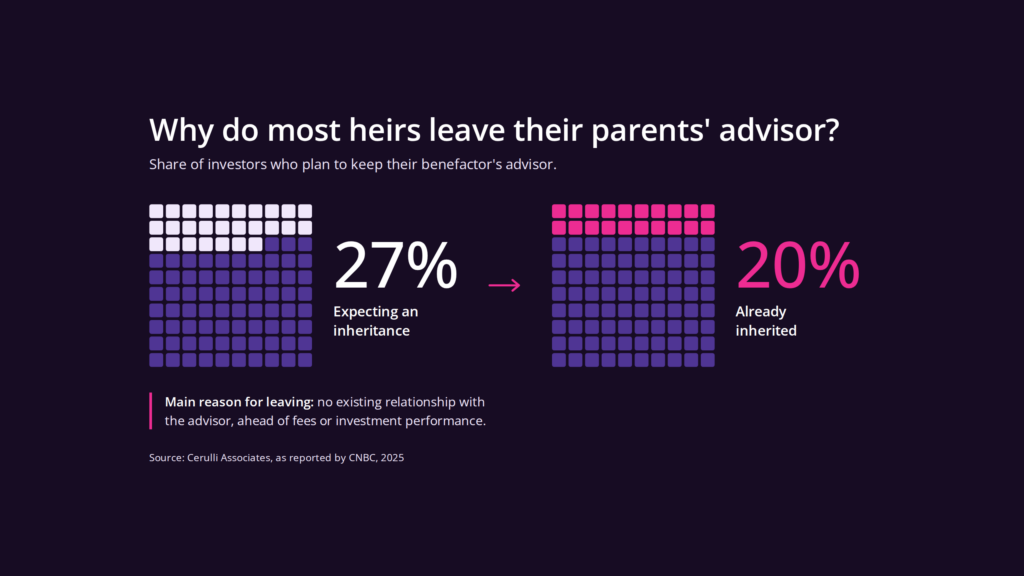
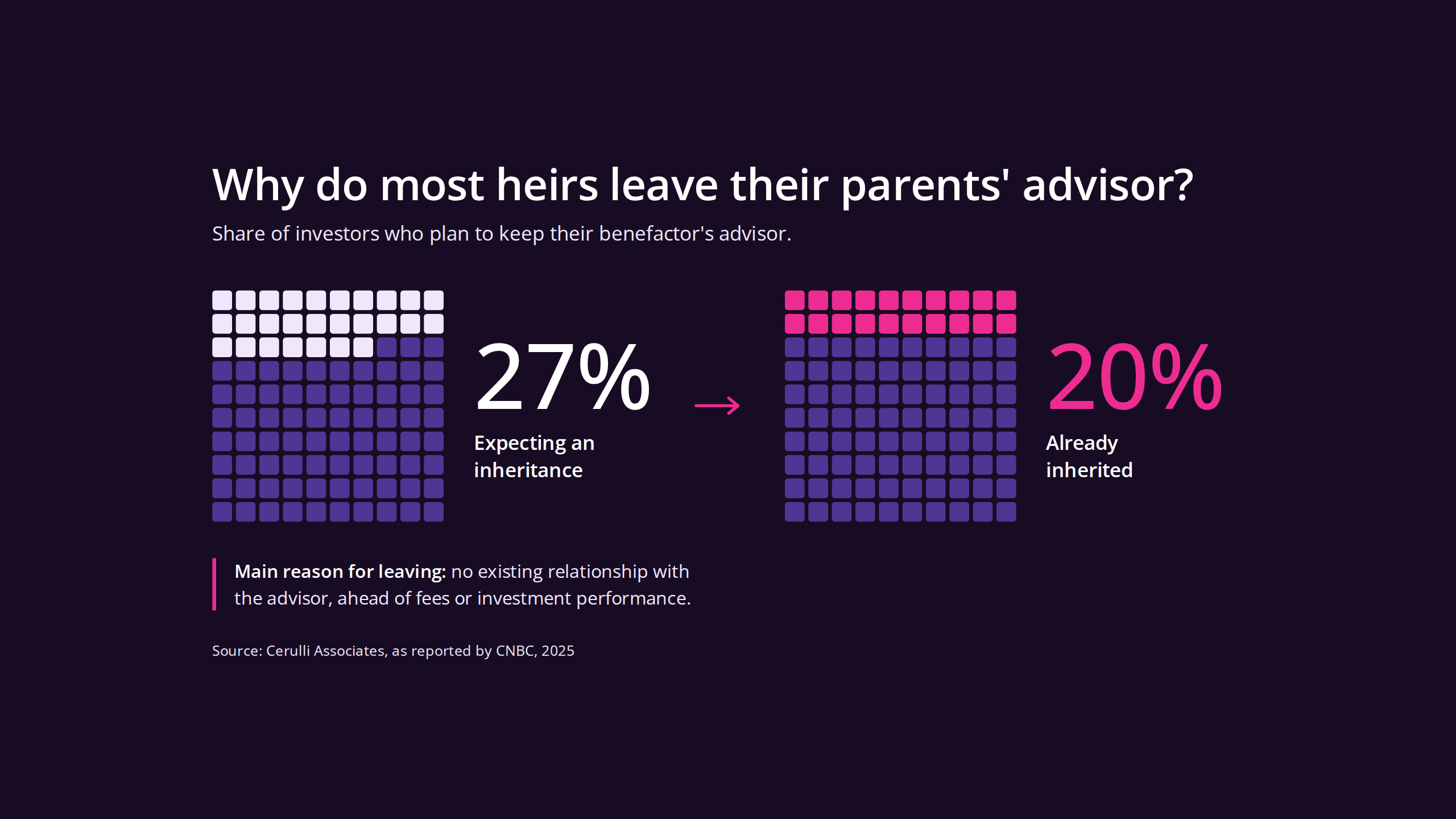
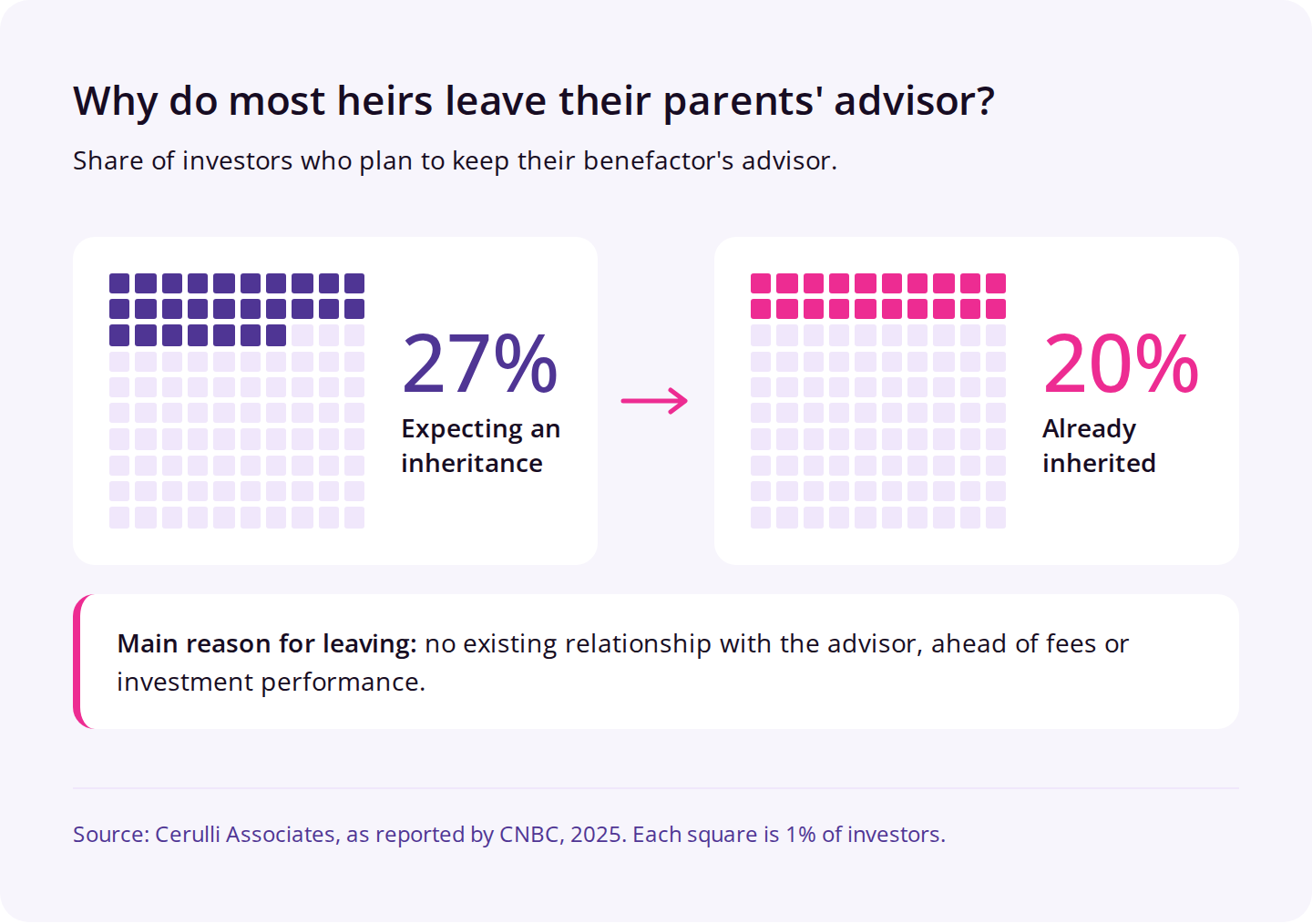
Why do most heirs leave their parents' advisor?

Cerulli’s John McKenna told CNBC that among investors expecting an inheritance, only 27% plan to keep their benefactor's advisor. That figure falls to 20% among those who have already inherited their wealth. Investors cited the absence of an existing relationship with the advisor as the primary reason for leaving, ahead of fees or investment performance.

When the wealth transfer is framed purely as a demographic or actuarial event, communication falls through the cracks. The asset moves to a household the institution has communicated with, if at all, as a name on a joint statement. The relationship the advisor built over 20 years does not transfer with the account. It has to be built from scratch, usually under time pressure and during bereavement.

Among investors expecting an inheritance, 27% plan to keep their benefactor's advisor. Among those who have already inherited, 20%.

What does this mean for how institutions communicate?

The industry’s first response to the wealth transfer has largely been a staffing answer. Institutions hire younger wealth managers, build next-gen programmes, and train relationship managers (RMs) to talk about crypto and ESG. While these are reasonable moves, they leave the underlying communication gap unresolved.

The actual failure point occurs much earlier and is more structural. Institutions do not lack research or insight to share with the next generation; they lack a way of making that research land as something a 35-year-old heir would read, understand, and act on.

A technically excellent investment paper written for the primary client does not automatically translate to their adult children. Since most firms have no mechanism for reproducing a second version, an adapted version simply never gets created. The content pile-up compounds the relationship gap it should be closing.

Communication with the next generation also has to work across more channels and formats than the primary relationship did. The Harris Poll’s 2025 report found that younger heirs expect digital touchpoints in addition to a human advisor. An institution that can only produce one long-form format, at one cadence, for one reader, is not equipped for a household that now includes a 68-year-old client and a 34-year-old heir who inherited alongside them.

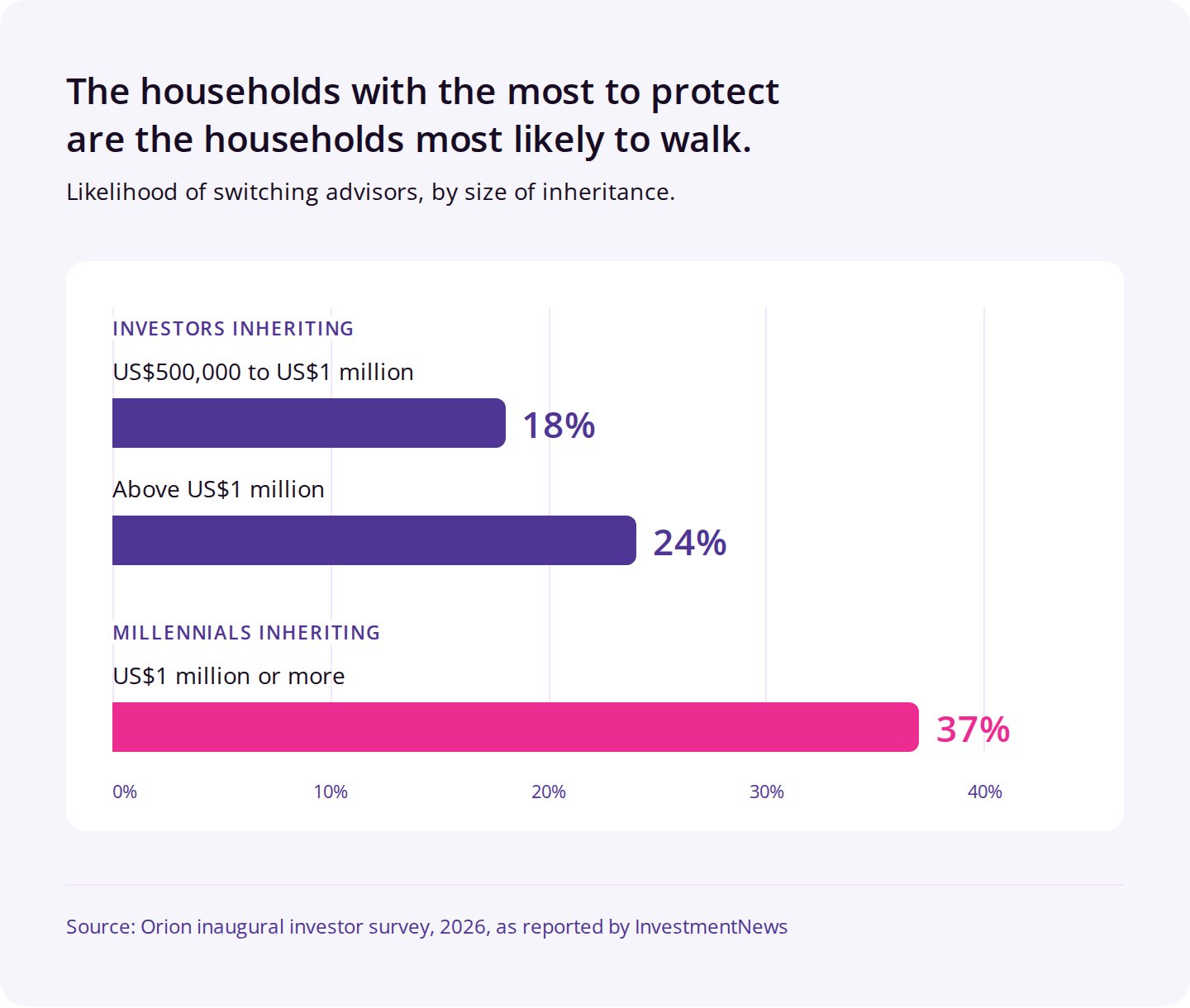
The retention risk also rises with the size of the inheritance. Orion’s 2026 inaugural investor survey found that investors inheriting between US$500,000 and US$1 million are 18% likely to switch advisors, rising to 24% for inheritances above US$1 million. Among Millennials specifically, that likelihood climbs to 37% for inheritances of US$1 million or more. The households with the most to protect are the households most likely to walk.

Likelihood of switching advisors: 18% for inheritances between US$500,000 and US$1 million, 24% above US$1 million, and 37% for Millennials inheriting US$1 million or more.

Is this a US problem, or does it apply in the UK and Asia too?

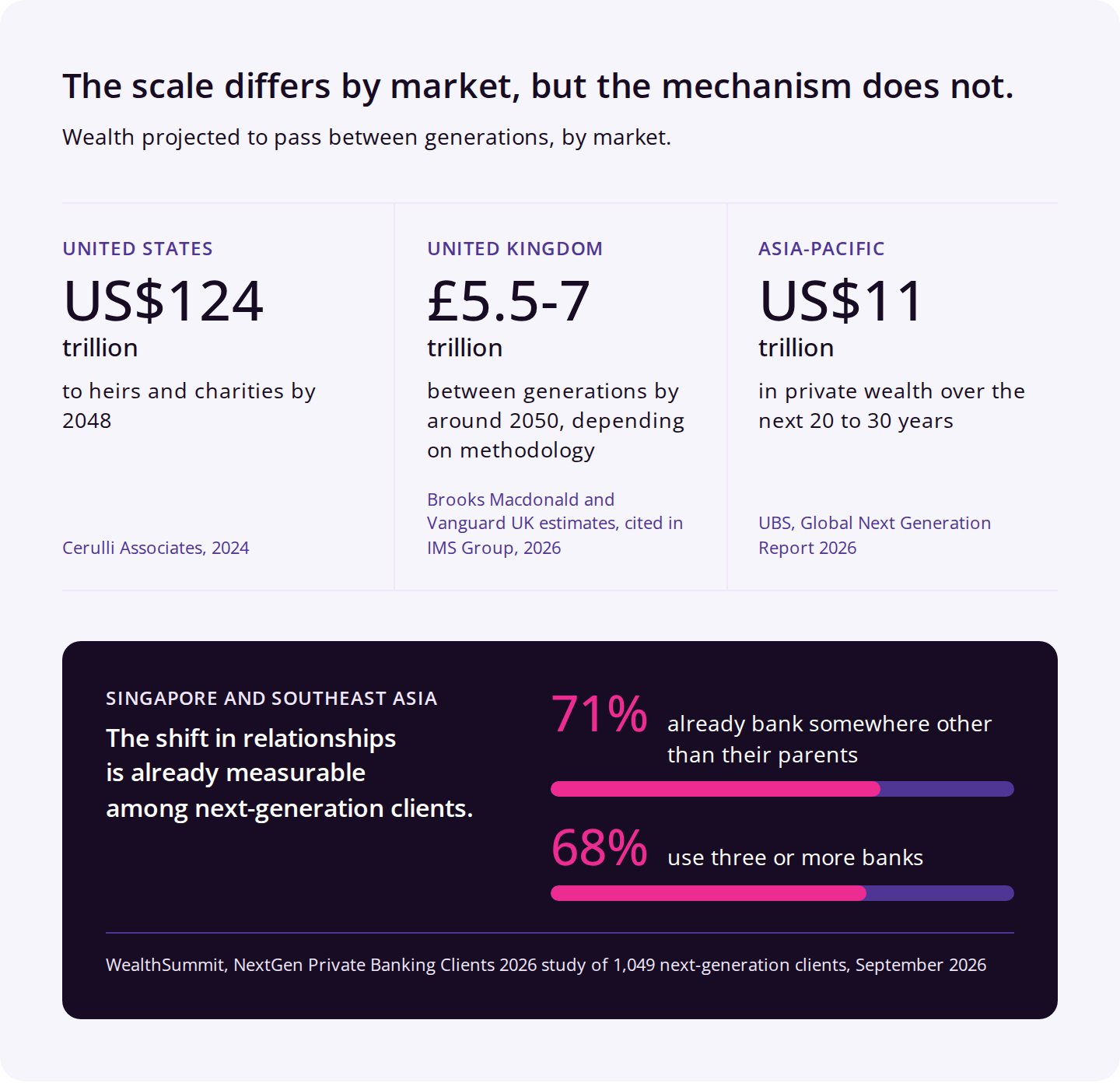
The scale differs by market, but the mechanism does not. In the UK, an estimated £5.5 trillion to £7 trillion is projected to pass between generations by around 2050, depending on methodology (Brooks Macdonald and Vanguard UK estimates, cited in IMS Group, 2026). In Asia-Pacific, UBS estimates that US$11 trillion in private wealth will change hands over the next 20 to 30 years (UBS, Global Next Generation Report 2026).

In Singapore and Southeast Asia, the shift in relationships is already measurable. WealthSummit’s NextGen Private Banking Clients 2026 study of 1,049 next-generation clients found that 71 percent already bank somewhere other than their parents, and 68 percent use three or more banks (WealthSummit, September 2026). Across all three markets the underlying problem is the same: the primary relationship was built with one generation, using formats and a cadence suited to that generation, and there is no equivalent relationship, format or cadence in place for the one that inherits.

US$124 trillion in the US by 2048, £5.5 trillion to £7 trillion in the UK by around 2050, and US$11 trillion in Asia-Pacific over 20 to 30 years. In Singapore and Southeast Asia, 71% of next-generation clients bank somewhere other than their parents and 68% use three or more banks.

What should institutions do before the transfer happens?

Retention research points to the same conclusion. Cerulli's analysis attributes low retention primarily to absent relationships. That means the window for action opens long before the inheritance event takes place. Firms that treat next-generation engagement as a once-off onboarding step after an heir has already inherited are acting after the relationship has already been decided.

The practical shift is to make communication a continuous element of the primary relationship, integrated well before any life event triggers a transfer. That means producing content and updates in formats the next generation actively consumes and delivering them on a consistent schedule. It also requires proof of engagement. An advisor walking into a family meeting should know whether the heir has read any previous communications.

Quantity is not the constraint, as institutions already publish research, market updates and commentary. The challenge is turning that volume into bite-sized formats an heir who has never met the advisor will actually engage with, and knowing whether it worked.

US$124 trillion

is projected to transfer from older generations to heirs and charities through 2048, with Millennials alone inheriting an estimated US$46 trillion over the next 25 years.

Source: Cerulli Associates, "Cerulli Anticipates $124 Trillion in Wealth Will Transfer Through 2048," 2024.

Upscale

Next-gen engagement is a business opportunity. It's a rare chance to gain competitive advantage. However three significant challenges prevail. The first is the usual excuse that there are more business critical issues – compliance challenges, core digital transformation challenges. The next is that short-termism prevails particularly for those companies listed on the stock market. Where is the revenue coming from next quarter not in 5 years time. The third is the most profound. There is a huge talent gap when it comes to engagement. The industry has been built by investment and relationship professionals not by digital engagement professionals. The result is a lack of understanding on what is needed to engage today and tomorrow's client. And let's face it, the industry is not that attractive to these professionals who can find homes in more creative and fast moving industries. The only way out – focus on content engagement with an expert partner that makes transformation much faster and cost efficient than needing huge projects. The need is getting louder and louder. The winners will be those moving on this now.

Dominic Gamble

Dominic Gamble

CEO and Co-founder, Upscale

Frequently Asked Questions

What is the great wealth transfer?

The great wealth transfer is the movement of assets from older generations to heirs and charities. Cerulli Associates projects US$124 trillion will transfer in the US by 2048, with US$105 trillion going directly to heirs.

How much will millennials inherit?

Cerulli Associates estimates millennials will inherit US$46 trillion over the next 25 years, more than any other generation.

Why do heirs leave their parents’ financial advisor?

The main reason is the lack of an existing relationship, ahead of fees or performance. Cerulli found only 27% of investors expecting an inheritance plan to keep their benefactor’s advisor, falling to 20% among those who have already inherited.

What do younger heirs expect from wealth managers?

The Harris Poll’s 2025 research found younger heirs expect digital touchpoints alongside a human advisor, not instead of one.

Does the great wealth transfer affect the UK and Asia too?

Yes. An estimated £5.5 to £7 trillion will pass between generations in the UK by around 2050, and UBS estimates US$11 trillion in private wealth will change hands across Asia-Pacific over the next 20 to 30 years.

How can wealth managers retain the next generation?

Start engaging heirs well before any inheritance, communicate continuously in formats they already use, and measure whether they are reading what you send before key family meetings.


You may also like

Technology
27 October 2026
Most compliance teams do not distrust what a language model can write. They distrust what happens to it afterwards. The distinction between an open model and a guardrailed workflow is where that trust is won or lost.
Independent Wealth Managers
12 October 2026
Technology
12 October 2026
For firms producing dozens of fund or strategy factsheets each reporting period, most of the time goes into coordination: data from several systems, multiple stakeholders manually contributing, repeated review rounds and a separate edition for every distributor. A connected production workflow removes most of those handovers and shows which distributors engage with the result.
Get in touch