
Financial institutions should not have to choose between the limitations of generic software and the cost and complexity of building everything themselves. A better approach combines proven engagement infrastructure with tailored extensions: the speed of SaaS with the flexibility of a custom build.
1. The engagement challenge is bigger than a software decision
Wealth managers, asset managers and private banks already possess substantial expertise, insight and intellectual property. They produce market commentary, investment research, product information, client communications and thought leadership every day.AI has made it faster and easier to produce and adapt this material. But creating more content does not necessarily make that content more useful.
The harder task is ensuring that approved knowledge is easy to find, relevant to the audience and available through the right channel at the right time. Firms must also be able to understand what happens after that information is distributed.
Clients expect relevant information and consistent digital experiences. Advisers and relationship managers need to find, adapt and share approved material without navigating several disconnected systems. Marketing teams need to extend the reach and value of the content the firm already produces. Compliance and governance teams require appropriate oversight and control. Management needs evidence that this activity is contributing to meaningful engagement. Engagement is therefore a business and operating-model challenge, not simply a software-development project.
Illustrative example: A typical product launch
Consider a typical product launch. The investment team publishes the approved research, marketing adapts it into campaign material, sales teams prepare adviser communications, and relationship managers personalise follow-up for clients. When these activities rely on disconnected systems, information has to be searched for, reformatted and shared manually. Advisers spend more time preparing than engaging, while management has little visibility into which content or conversations are actually influencing commercial outcomes.
2. “Build or buy” creates a false choice
Technology decisions are often presented as a choice between buying a standard product or building something bespoke. Buying can be faster, but may force organisations into generic workflows. Building offers greater flexibility, but also requires more time, investment and long-term ownership. For most financial institutions, neither approach is sufficient. The real objective is not to own more technology. It is to build the right engagement capability with the least unnecessary risk, complexity and ongoing maintenance.
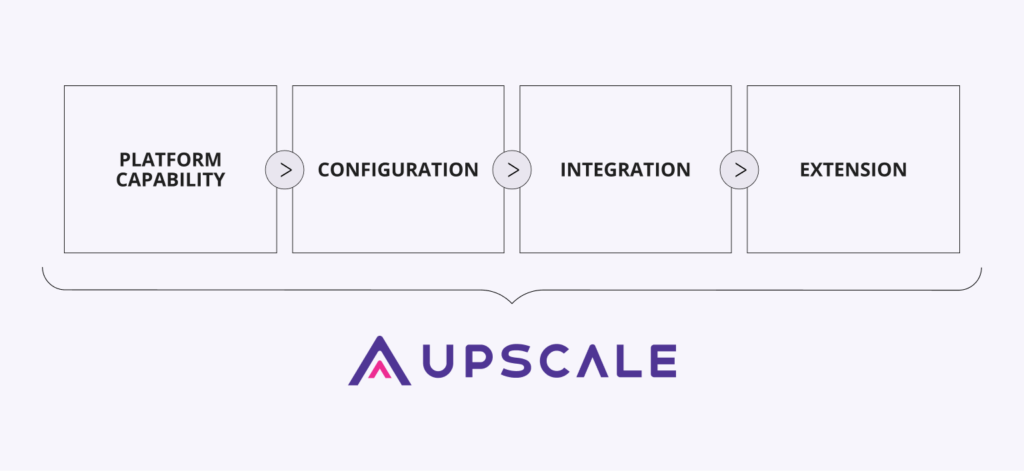
That starts with separating what should be common from what should be distinctive. Common capabilities are better delivered through proven, reusable infrastructure. The workflows, integrations and experiences that make an organisation different should be configured or extended where they create genuine business value. This is not a compromise between building and buying. It is a more practical model that combines a proven engagement platform with tailored extensions around an organisation's users, data, systems, governance requirements and client journey.
3. Start with the platform
A financial institution should not need to rebuild the foundations of modern engagement for every new client experience or internal workflow. The platform provides the shared infrastructure to generate, access, distribute and measure engagement:
Generate: Transform existing knowledge into useful formats and digital experiences.
Access: Help the right users find and consume approved information more easily.
Distribute: Deliver relevant content through the appropriate channels.
Measure: Capture engagement signals that can inform follow-up and future decisions.
These capabilities can include AI-assisted content transformation, search and discovery, user and role management, distribution infrastructure, engagement analytics and integration foundations.
The platform sits alongside the institution’s existing technology, connecting content, people and channels without requiring wholesale replacement.
For example, a market outlook can be transformed into an adviser briefing and client summary, made available through a searchable content experience, distributed through an approved channel and measured to understand which themes attracted attention.
Reusable infrastructure removes the need to recreate the same foundations for every use case. The benefit is not only lower initial development effort, but faster access to a platform that continues to evolve.
4. Extend where the institution is genuinely different
A reusable platform does not mean every financial institution must operate in the same way. Client journeys, adviser workflows, approval processes, product structures, data sources and distribution models can all vary. These differences matter, but they do not justify rebuilding the entire technology foundation.
Extensions allow institutions to add tailored workflows, applications and integrations on top of proven infrastructure. They can connect an approved content repository, support a specific relationship-manager workflow, integrate engagement data with a CRM or create a digital experience shaped around the organisation’s own users and processes.
Because these capabilities are built on the shared platform, they are not disconnected bespoke development. They extend an existing product foundation where doing so improves adoption, connects important systems or supports a valuable business process. The result is the speed of SaaS with the flexibility of a custom build.
5. Configuration first, extensions where they add value
Not every requirement needs an extension. The first step should be to use an existing platform capability. Where needed, that capability can be configured for the organisation or integrated with an existing system. An extension becomes appropriate only when the remaining requirement creates sufficient business value to justify tailored execution.
This configurable-before-custom approach prevents flexibility from becoming an excuse to reproduce every legacy process. Distinctive workflows should be protected where they support a meaningful client, adviser or commercial outcome. Inherited complexity should be simplified rather than rebuilt. A specialist partner can help distinguish between the two, keeping the platform maintainable while preserving the institutional differences that genuinely matter.
6. The economics are about total ownership, not licence versus development cost
The relevant comparison is not a platform license against the budget for the first version of an internal build.
It is the total cost of operating, maintaining and improving the capability over time.
A standalone product requires continued investment in product ownership, engineering, testing, infrastructure, security management, integrations, user support, analytics, accessibility, governance, documentation and training. It must also evolve as channels, formats and operating requirements change.
The first release is therefore the beginning of the product lifecycle, not the end.
A platform-and-Extensions model separates the shared technology foundations from the areas that make the institution different. The platform carries the continuing investment in reusable capabilities, while Extensions concentrate tailored investment on the workflows, integrations and experiences that create business value.
This reduces the organisation-specific maintenance surface without limiting flexibility.
The economic advantage comes from building only what needs to be distinctive, rather than assuming responsibility for an entire standalone product.
7. Faster time to value without forcing a generic outcome
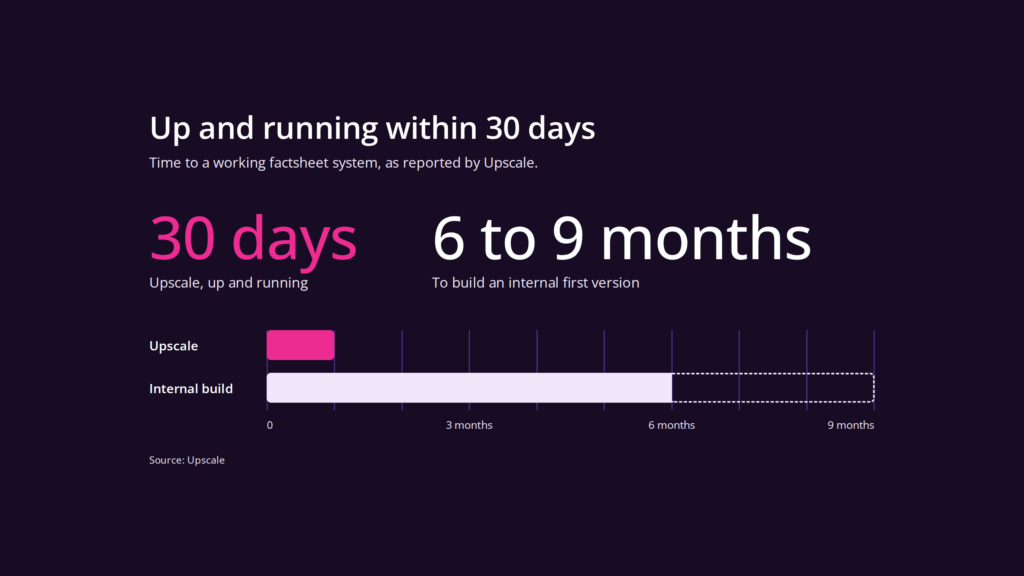
A full internal build often requires the underlying infrastructure to be designed before the institution can test whether the experience works for its users. This delays feedback, adoption and business value.
Starting with proven infrastructure changes the sequence. The institution can first define the business outcome and priority users, configure existing capabilities, connect essential systems and add Extensions only where they create meaningful value.
Practical sequence example from Upscale:
Confirm the outcome → Prioritise users and workflows → Configure → Integrate → Extend → Launch → Measure → Refine
This allows the institution to begin with a valuable use case, observe how people engage with it and improve the experience using real evidence.
The result? Faster proof of value without accepting a one-size-fits-all solution. Once the initial use case has demonstrated value, the institution can expand in a controlled way on the same consistent foundation.
8. Governance should apply across the whole engagement lifecycle
Governance should be designed into the engagement lifecycle from the outset, not added once the experience has been built.
Across modern engagement, financial institutions must govern approved content, user access, client information, communications and engagement data. That includes deciding who can access information, who can create, approve, adapt or distribute content, how information moves between systems, which AI-assisted activities require human oversight, what records need to be retained and how third-party integrations are monitored.
Upscale provides a shared engagement platform that brings these activities onto a consistent operational foundation. Rather than creating separate governance models for each workflow or application, common platform services can support multiple use cases across Generate, Access, Distribute and Measure. Extensions inherit or align with the same governance approach, avoiding uncontrolled parallel processes while allowing institutions to tailor workflows where required. This does not transfer regulatory accountability to Upscale.
Financial institutions remain responsible for vendor due diligence, internal governance, third-party oversight and ensuring the solution meets their own regulatory and organisational requirements.
Standardise the foundation. Differentiate the experience.
Build smarter engagement with the right platform, integrations and extensions.

9. Integration is part of the model, not an afterthought
Financial institutions already rely on systems of record, content repositories, identity services, marketing platforms and established client channels.
Upscale is designed to sit alongside this environment, not replace it or create another isolated destination.
API-led integration allows approved information, workflows and engagement data to move through the institution’s existing technology estate. Common integration infrastructure provides the foundation, while Extensions connect the systems and processes that are specific to the organisation without forcing those requirements into the core product for every client
A typical flow might begin with approved content from an existing repository, pass through the Upscale engagement layer, reach an adviser or client channel and return engagement signals that inform future decisions. This approach protects previous technology investments, reduces the disruption of wholesale replacement and makes the wider environment more useful by connecting knowledge, people, channels and engagement data.
10. Maintenance is a product decision
After launch, engagement technology must continue to evolve as user expectations, enterprise systems, distribution channels and AI capabilities change. In a wholly bespoke product, every component adds to the institution’s long-term responsibility for development, testing, integration and improvement.
With Upscale, the reusable platform foundation is maintained and developed as a core part of the product. This allows the institution to focus more of its attention on adoption, user experience and the Extensions that create distinctive value.
Those Extensions still require lifecycle planning and ongoing maintenance. They are not maintenance-free. The difference is that their scope is narrower and more deliberate because the entire solution has not been built from scratch.
The objective is to reduce the bespoke surface area, while continuing to invest in the workflows and experiences that genuinely differentiate the institution.
11. Consider the opportunity cost of rebuilding common infrastructure
Time spent rebuilding common infrastructure is time not spent improving client and adviser experiences, connecting valuable knowledge and data, designing better engagement journeys, establishing practical governance, supporting adoption or measuring and refining outcomes.
During a lengthy internal build, the fragmented processes the institution is trying to improve often remain in place. Adviser workflows stay manual, client experiences remain inconsistent and existing content continues to generate limited engagement.
The relevant question is therefore not only, “What will it cost to build?” It is also, “What value will be delayed while we build it?”
Starting with Upscale allows internal teams to focus their expertise on the decisions and experiences that are genuinely specific to the institution. Proven infrastructure supports the common foundations, while product attention can be directed towards adoption, user experience, valuable integrations and the Extensions that create meaningful differentiation.
12. A practical framework for deciding what to platform and what to extend
Each requirement should be assessed according to the outcome it supports, the value it creates and the level of ongoing ownership it introduces. Is it a common foundation? Ask whether the requirement is broadly shared by other financial institutions, whether a proven Upscale capability already supports the outcome and whether building it internally would create meaningful differentiation. Also consider whether it will require continuous technical investment
Likely response: Use the platform. Is it an organisational preference?
Ask whether branding, configuration, permissions or workflow settings can achieve the required outcome without bespoke code.
The institution should also consider whether the requirement is genuinely essential or simply preserves an inherited process that could be simplified.
Likely response: Configure the platform. Is it a system-specific requirement?
Ask whether the institution needs to connect an existing content repository, CRM, identity service, portal or distribution channel. Consider whether Upscale’s existing integration infrastructure can support the requirement, what data needs to move, in which direction and under whose control.
Likely response: Integrate with the platform. Is it a genuine differentiator?
Ask whether the workflow or experience is materially important to clients, advisers or the operating model, whether it creates measurable business value and whether it is sufficiently stable and important to maintain. It should also be possible to build the requirement on Upscale’s shared platform infrastructure rather than as a disconnected standalone product.
13. The better answer is a shared foundation with tailored execution
Financial institutions should not have to choose between a rigid product and a ground-up build. Upscale combines reusable, AI-enabled engagement infrastructure with tailored Extensions for the workflows, applications and integrations that matter to each institution. Specialist financial-services expertise helps determine where standardisation should end and differentiation should begin. This is one engagement model, not separate platform and development businesses.
The result is faster time to value, lower unnecessary complexity and greater flexibility where it creates business value. Engagement remains the outcome. The platform, AI and Extensions are the enablers.
Conclusion
The right question is not whether to build or buy an engagement platform. It is which capabilities should be shared, which should be configured and which are valuable enough to extend.
Upscale combines proven engagement infrastructure with tailored execution. The platform provides the common foundation to generate, access, distribute and measure engagement. Extensions adapt that foundation around the workflows, integrations and experiences that make each institution different. It is the industry understanding of a specialist partner, the speed and scalability of SaaS, and the flexibility of tailored execution—delivered through one engagement model.
Subscribe to our newsletter
A monthly or so newsletter that sums up all our news, tips, insights and observations from the world of sales engagement in the wealth management eco-system.