
Competition for assets is intensifying, product ranges are expanding and distribution teams, intermediary partners and consultants are expected to communicate increasingly complex strategies. Therefore the response is to build a more connected model for turning investment expertise into relevant engagement and giving distribution teams what they need to move conversations forward.
AI will reshape the operating model
CIO views, portfolio-manager commentary, product research and client questions all contain information that can support positioning and distribution. The challenge is turning that knowledge into usable communications quickly and consistently. AI-assisted workflows can help teams structure approved research, create audience-specific drafts and adapt the same source material across channels. This reduces manual production while preserving the firm’s central investment narrative.
For product marketing teams, that makes the application of AI more important than AI adoption itself: using it within governed workflows to make existing expertise more accessible, relevant and useful.
of organisations are scaling AI, only 5% have become truly "AI future-built" businesses that consistently translate AI into measurable commercial outcomes. Meanwhile, 60% report little or no material value despite significant investment.
Source: Boston Consulting Group (BCG), Build for the Future research

Personalisation must move beyond the client’s name
Product communications are often segmented by broad categories such as institutional, intermediary or retail. These categories remain useful, but they rarely reflect the full context behind an investment decision.
A discretionary manager researching private credit has different requirements from an intermediary evaluating income strategies for its client base. Personalisation takes into account the type of investor or intermediary, the portfolio's role, the investment objective, risk profile, previous engagement, stage in the decision process, and preferred communication channel, with AI and engagement data helping match approved product content to each of these needs. But relevance at the level of an individual communication is only part of the opportunity. Product marketing also needs to connect those interactions across the wider decision journey.
Digital distribution becomes a connected journey
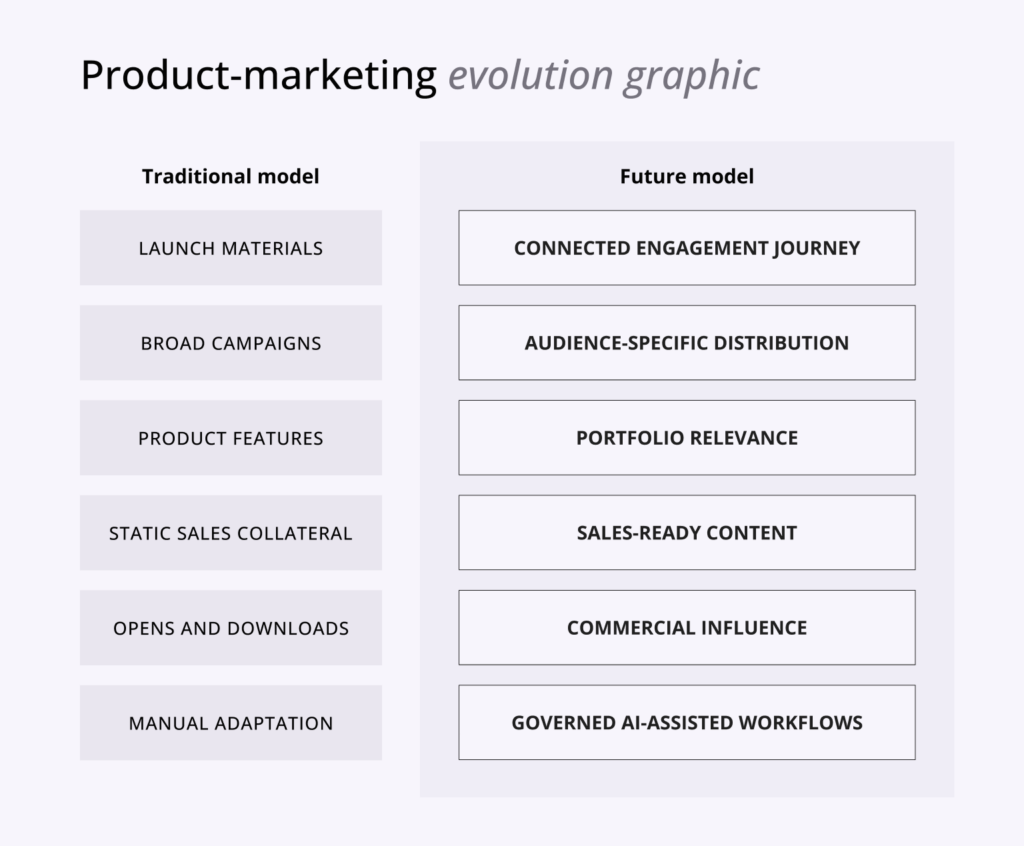
Most product launches still revolve around a single date. Materials go out, an email gets sent, sales teams start working their networks, and then momentum fades as everyone's attention moves on to the next thing. The trouble is, investment decisions rarely happen off the back of one communication.
A better approach treats the launch as a sequence rather than a single moment: begin by defining the market opportunity, introduce the firm's investment perspective, explain where the strategy fits within a portfolio, support it with product details and evidence, equip distribution and sales teams with the right materials to continue the conversation, and use engagement data to guide timely, relevant follow-up.
That turns a launch into something closer to a journey than a moment, one that might move across research articles, emails, webinars, social content, client meetings and digital product pages. Each touchpoint adds to what the client understands, not just repeating the same pitch in a different format. And because many of those journeys are ultimately advanced through people, digital distribution and sales enablement need to work together rather than as separate activities.
Sales enablement is central
Product marketing often concentrates on the end investor. For many Asset Managers, however, private bankers and intermediaries remain the route to that investor. Their ability to understand and explain a product is therefore critical.
Distribution enablement includes more than a full presentation and factsheet.
This is particularly important as firms introduce alternatives, private-market strategies and more personalised investment solutions. Product complexity can create opportunity, but only when intermediaries are equipped to explain it credibly. Equipping distribution teams is one part of the equation. Firms also need to understand whether those materials and interactions are actually contributing to commercial progress.
Distribution enablement includes more than a full presentation and factsheet. It will provide:
This is particularly important as firms introduce alternatives, private-market strategies and more personalised investment solutions. Product complexity can create opportunity, but only when intermediaries are equipped to explain it credibly. Equipping distribution teams is one part of the equation. Firms also need to understand whether those materials and interactions are actually contributing to commercial progress.
Measuring what actually matters
Launch emails, downloads and page views tell you something, but they don't tell you the whole story about how product marketing is actually performing. A better framework connects that activity to real outcomes, things like distribution adoption, qualified engagement, product enquiries, meetings generated, sales follow-up, pipeline influenced, progression toward allocation, product adoption, assets raised or retained, and time saved in production.
That shifts how the whole function gets judged. It's no longer really about how much content got produced, but about whether that content actually helped someone take a meaningful next step.
There's a real gap worth paying attention to here. PwC found that 80% of Asset Managers believe emerging technologies will drive revenue growth, yet only 20% are actually using those technologies to enhance tailored investment advice.
The challenge is no longer deciding whether to adopt AI, but integrating it into governed product marketing workflows that improve distribution efficiency, personalisation and commercial outcomes.
That gap between belief and execution is exactly where the opportunity sits. Closing that gap requires the different parts of product marketing to work as one connected system: investment expertise, content, distribution, sales enablement and engagement insight.
Subscribe to our newsletter
A monthly or so newsletter that sums up all our news, tips, insights and observations from the world of sales engagement in the wealth management eco-system.