Why does factsheet production take so long?
For many asset managers, the factsheet is one of the most important documents they send to distributors and clients. Steeped in historical routine and regulatory necessity, their compilation is also one of the most fragmented jobs in the business. Data, commentary and design arrive from different systems and people.
A middle office team brings the asset manager marketing material together, legal and compliance review it, and changes travel back and forth by email. A poor team of designers or worse junior staff are fiddling around with tools inadequate for design, and if an external production partner is involved, each handover adds time and another chance for error.
Finding the inputs is often the first delay. Asked where their content lives, institutions typically say SharePoint. Then they add that it is out of date, the wrong draft is attached to an email, and the rest sits with a named colleague.
For firms producing dozens of factsheets every period, the work is too large to manage comfortably through spreadsheets, email chains and manual design. Yet many have no dedicated production system. Every new fund and every new distributor relationship adds to the workload, and skilled teams spend days coordinating documents instead of working with clients and distributors.
Why do review rounds keep restarting?
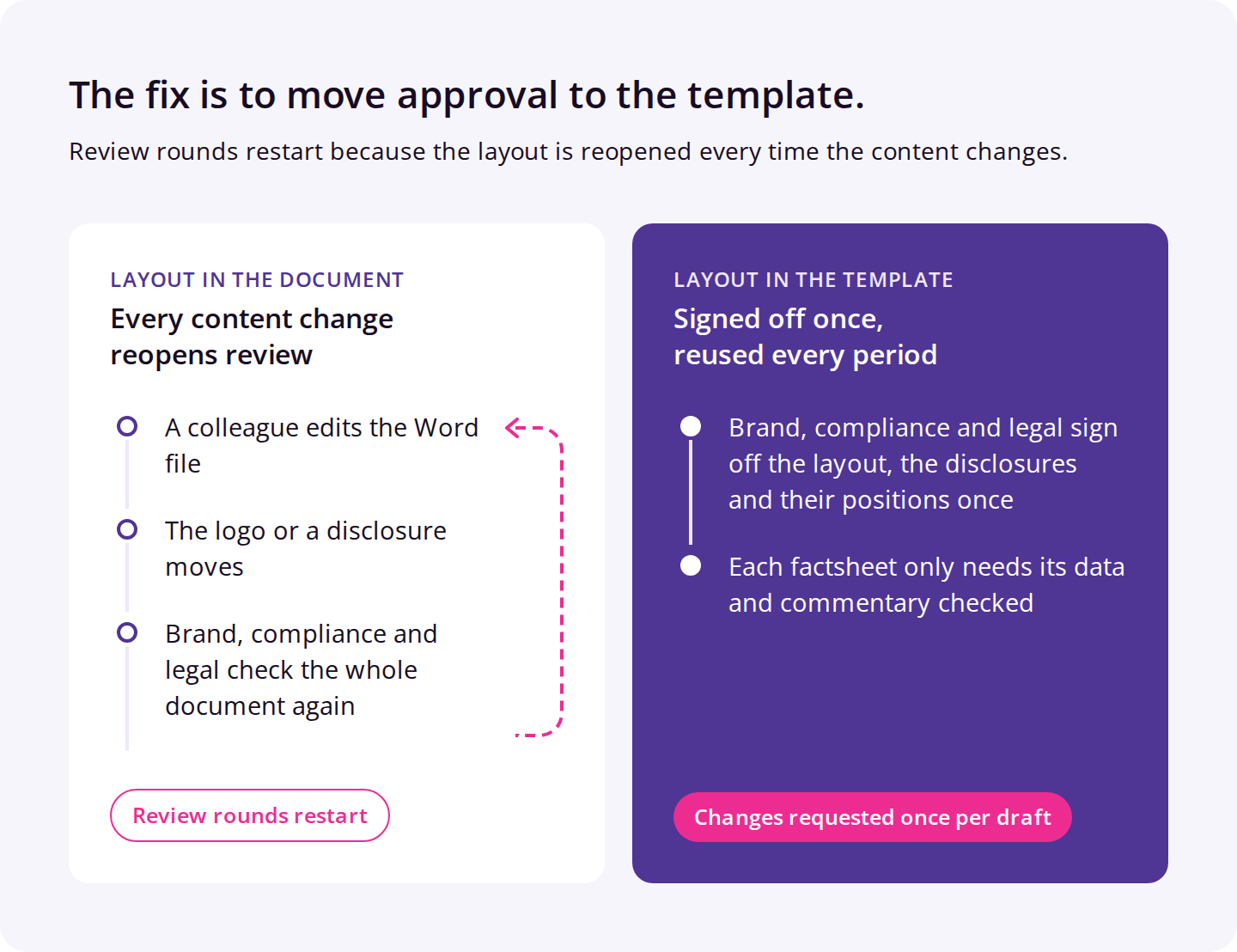
Review rounds restart because the layout is reopened every time the content changes. A product or research colleague edits the Word file and moves the logo or a disclosure. Brand, compliance and legal then have to check the whole document again.
The fix is to move approval to the template. Brand, compliance and legal sign off the layout, the disclosures and their positions once. After that, each factsheet produced from the template only needs its data and commentary checked.
Approvers also work faster when the factsheet and its summary formats arrive together, from one confirmed source. They can then request changes once per draft rather than across separate email threads.
What makes white labelling hard at scale?
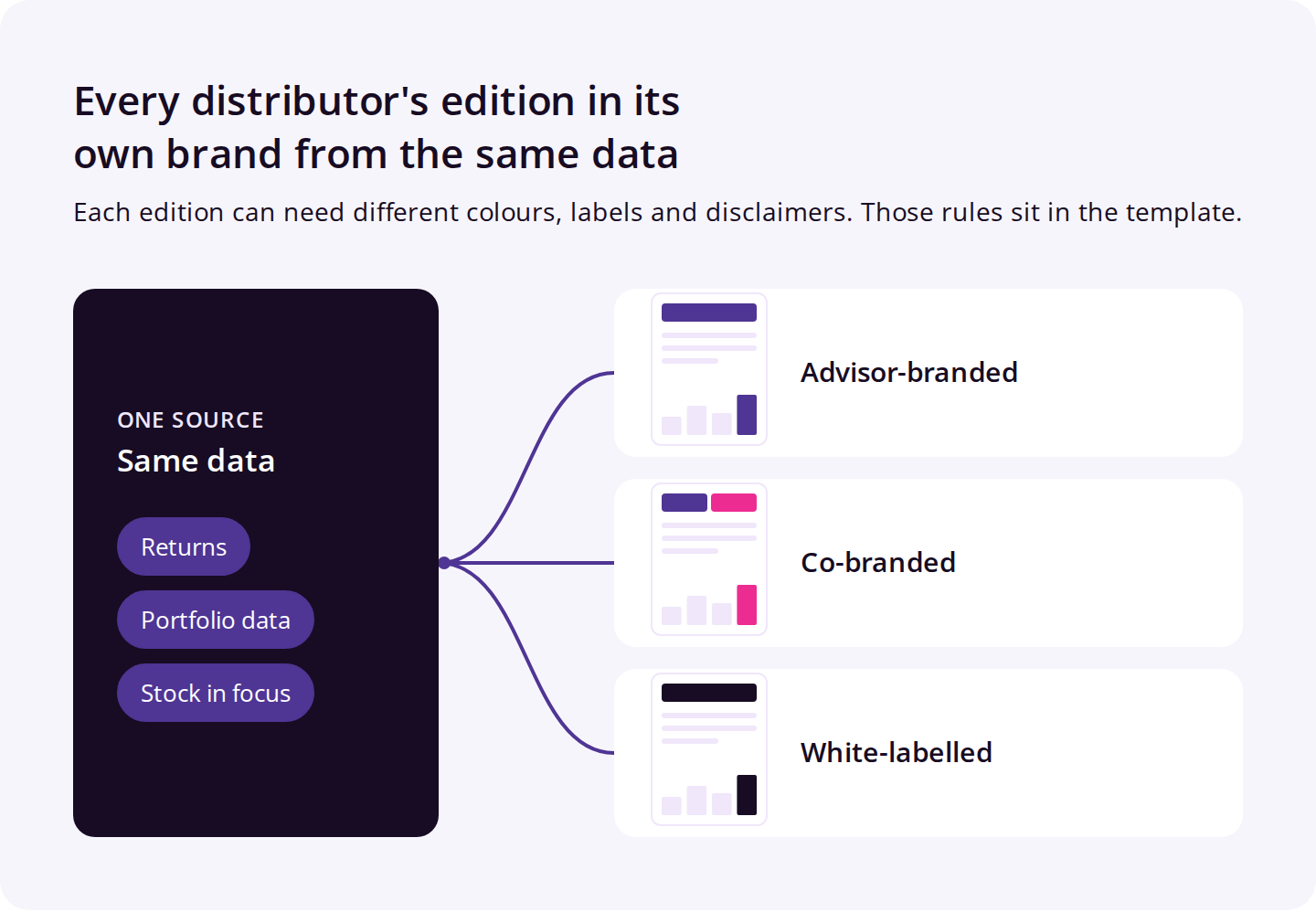
Many investment managers produce factsheets for distributors under the distributor's own brand, or alongside their own. Each edition can need different colours, labels and disclaimers. Rebuilding the document for every partner multiplies the work with each new relationship.
Brand rules also affect meaning. A distributor's brand colour may be red, but red also reads as negative on a chart, so a rising figure still needs a green arrow. Rules like this belong in the template, not in a designer's memory.
When the rules for each edition sit in the template, advisor-branded, co-branded and white-labelled versions come from the same data without recreating the document.
What does a connected factsheet workflow look like?
Inside Upscale’s software, a monthly factsheet cycle runs through one governed workflow, with version history and an audit trail.
Stage
What happens
1
Month starts
Last month's items and figures are cloned and marked as not yet updated
2
Data requests
Data owners are asked for the period's returns, market updates, or portfolio strategy updates with reminders. Bulk spreadsheet upload or API to data feed are both possible
3
Templates updated
Returns, portfolio data and the stock in focus go into the template
4
Generate
Factsheets are produced, with every distributor's edition in its own brand from the same data
5
Review
Approvers are notified and status is tracked per factsheet
6
Publish
Approved PDFs are rendered, bundled and delivered, for example to SharePoint or the existing campaign marketing tool
Fixed figures do not pass through a language model. Ben Backx, Upscale's co-founder and CTO, explains that fixed data such as product terms is taken from a source system and placed straight into the template. AI is reserved for interpretation tasks such as summary drafting/review assistance. "It's form-filling rather than essay writing," he says.
How do you show distributors what has changed?
A finished factsheet contains the detail readers need. But a distributor should not have to compare two long documents to find what changed since the last period. For an independent financial advisor (IFA) network receiving updates across many funds, that comparison rarely happens.
Upscale’s Content Transformation Studio turns the approved factsheet into shorter, branded summaries, such as a video, carousel or concise PDF. These highlight the changes that matter and link back to the full document. Upscale reports that a PDF can become a video in minutes, compared with days through an agency, with no design skills required.
5 minutes
from PDF to video, compared with 2 days through an agency.
Source: Upscale, 2026

How do you know which distributors read it?
Publication is only part of the job. Firms also need to know whether factsheets reach the right people and hold their attention. An emailed attachment gives no signal back.
Upscale distributes approved content through branded, trackable advisor experiences or through existing marketing channels. Teams can see ‘sales signals’ on which factsheets recipients open, which summaries they view and how engagement changes over time. Upscale reports 3x higher open and consumption rates compared with generic outreach.
Engagement is measured on first-party interaction with material the firm itself sent: time spent on each page and which format the reader chose.
These signals give distribution and relationship teams a starting point for their next conversation. A contact who returns after three months, or a partner whose engagement has risen across consecutive sends, may warrant a call. So may a previously active partner who has gone quiet.
How long does it take to get started?
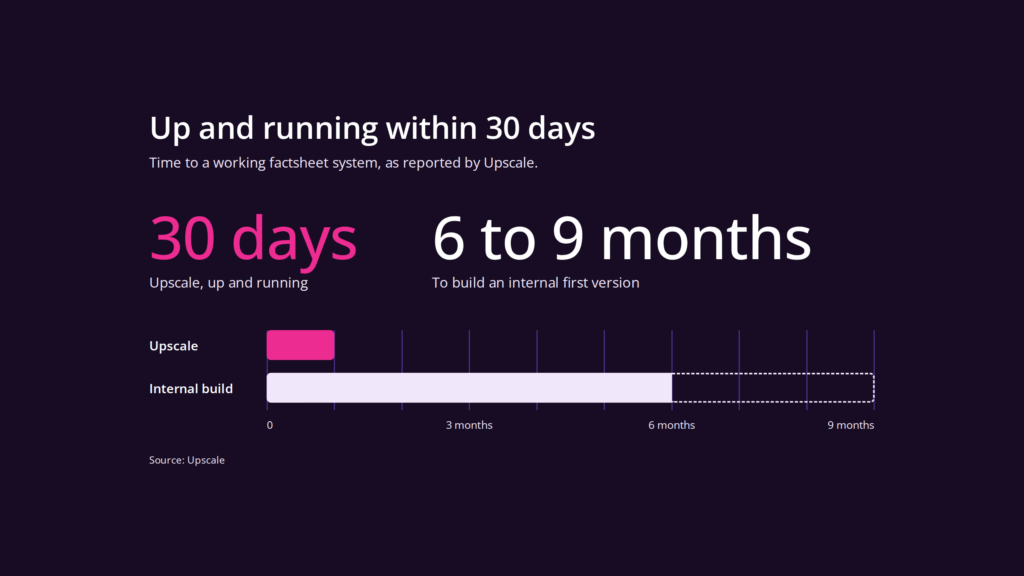
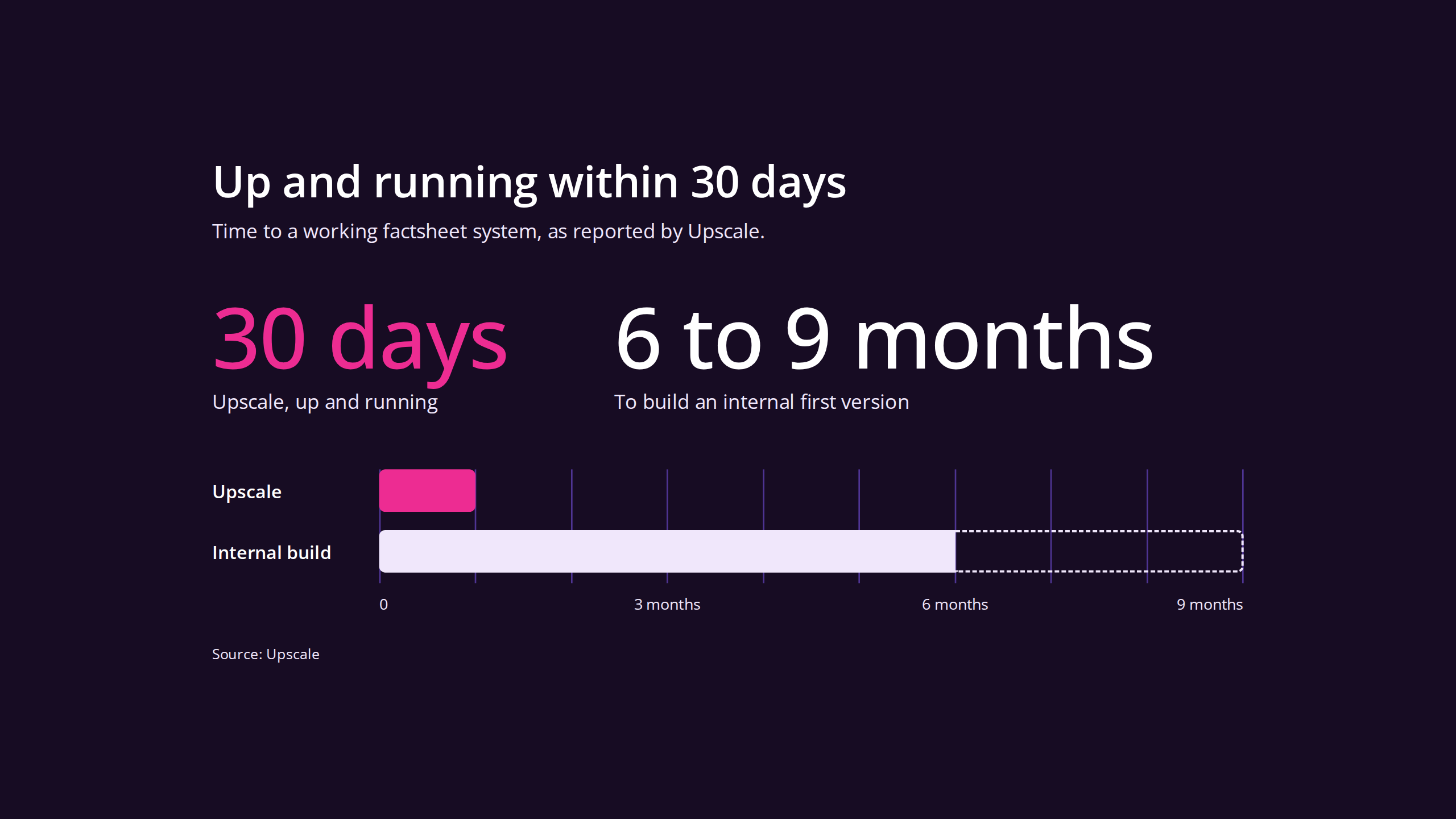
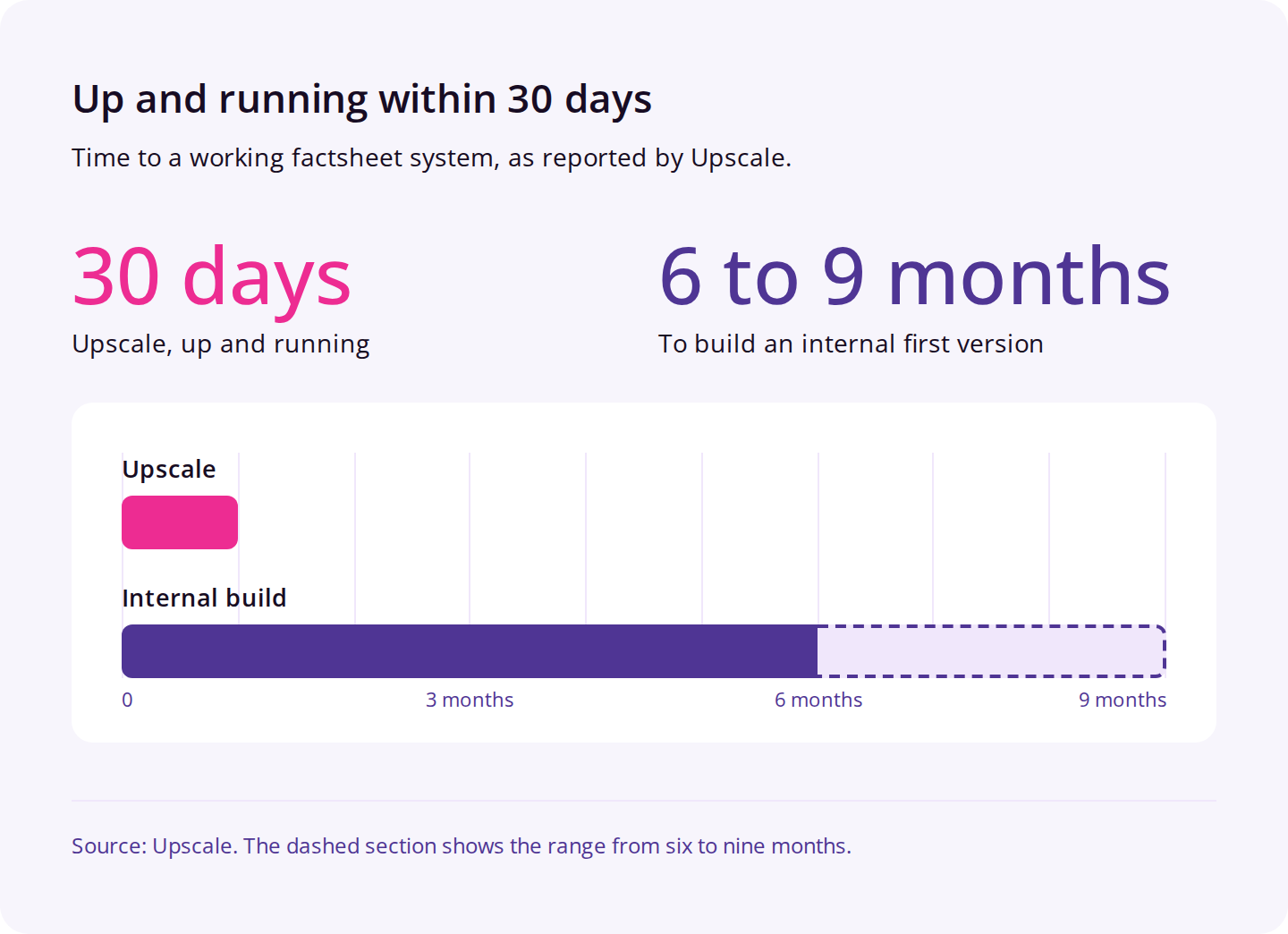
An internal factsheet system is fast to get going and does not require integrations on day 1.. Upscale reports that firms are up and running within 30 days, compared with six-to-nine months to build an internal first version. Firms can start with one recurring factsheet workflow and expand from there.
FAQ
Does AI generate the figures in a factsheet?
No. Fixed data comes from source systems and /or spreadsheets that are integrated and / or uploaded into the template. AI is used to help draft summaries, and a human approves before anything is published.
Can each distributor get its own branded edition?
Yes. Advisor-branded, co-branded and white-labelled editions are produced from the same data, using rules set in the template.
Does it replace our current distribution tools?
No. Upscale can help the firm distribute through its out-of-the-box trackable experiences or work with an existing distribution setup.
About Upscale
Upscale connects factsheet production, white labelling, summaries and distribution in one workflow. Teams spend less time moving files between colleagues and agencies. Distribution teams get engagement signals they can act on. Founded in Singapore in 2021, Upscale works with wealth and asset management firms across Asia, Europe and North America.
Producing 10-100 fund or strategy factsheets a month or quarter? Speak with Upscale about simplifying production and making every update more useful to your distributors.