Menu
Close
When analysing the 2026 market outlooks, one conclusion is unavoidable: directional consensus is unusually tight. Across more than two dozen CIO reports, the same baseline assumptions appear again and again.
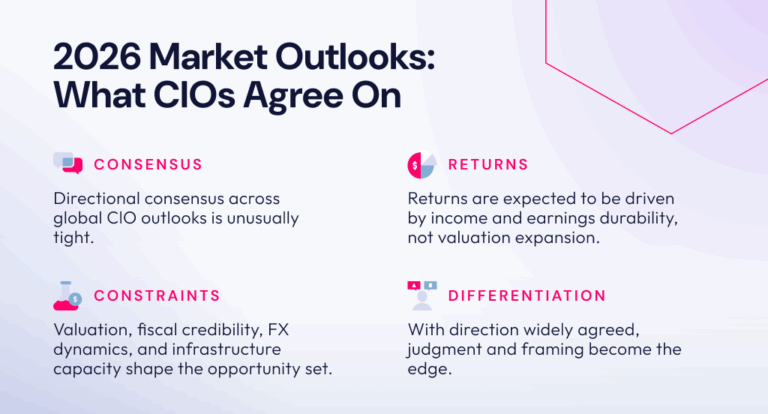
What makes the 2026 outlook unusual is not the direction of the consensus, but its density. When expectations cluster this tightly, even modest deviations in sequencing or assumptions can have outsized effects on outcomes.
US equities are expected to move higher, the dollar to weaken, and returns in fixed income to come primarily from yield rather than price appreciation. In that sense, markets appear positioned for a familiar “set menu” of outcomes.

Source: Vanguard, 2026 Outlook
The real challenge for portfolio construction, however, is no longer identifying the consensus. It is deciding which differences within that consensus actually matter..
Across the outlooks reviewed, the tone is modestly constructive but cautious. After strong gains in recent years, few CIOs are willing to argue for another year of outsized returns, yet equally few are prepared to be the first bear in the room.
Several themes recur with striking consistency:
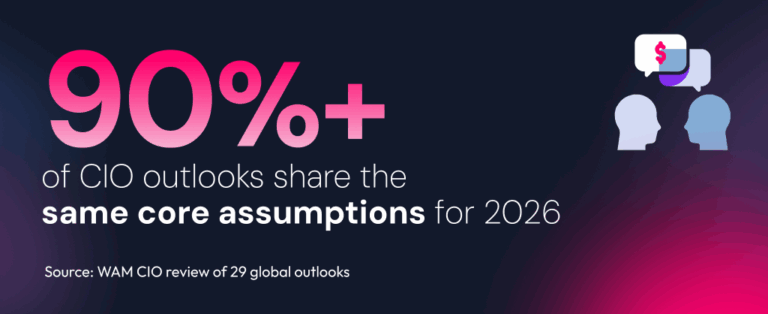
In our review of 29 outlooks, more than 90 percent of CIOs shared these core assumptions. The consensus is not only clear, it is crowded.
Despite the shared direction, the outlooks diverge meaningfully in what they emphasise as the key risks and constraints.
Several institutions stand out for elevating issues others treat as secondary:
“High public debt levels mean fiscal policy will remain constrained, increasing sensitivity to shifts in market confidence.”
Capital Economics, 2026 Outlook


These are not disagreements about where markets are headed. They are disagreements about what matters most along the way, and they cannot all dominate at once.
Time horizon is one. Many “only views” differ primarily on whether a risk is relevant in 2026 or over a longer cycle. Valuation constraints, for example, may not derail markets in the near term, but they shape return expectations beyond it.
Sequencing risk is another. The order of events often matters more than the events themselves. Does dollar weakness arrive smoothly or episodically? Do rate cuts precede fiscal stress, or follow it? Does AI productivity materialise before infrastructure and power constraints begin to bind? Portfolios built for smooth outcomes are more vulnerable if the sequence changes.
EM real yields remain unusually high relative to developed markets
This reflects relative policy rates and inflation dynamics cited across multiple CIO outlooks, rather than a single point estimate.
Constraint hierarchy is equally important. Not all risks bind at the same time. Fiscal sustainability, infrastructure capacity, FX volatility, and liquidity conditions compete for primacy. Judgment lies in identifying which constraint is most likely to dominate first.
Finally, there is portfolio sensitivity. The real risk is often not being wrong on direction, but being exposed to a single assumption breaking. Tight credit spreads, benign FX moves, or stable correlations are frequently taken for granted.
A narrow consensus can mask fragilities, particularly where portfolios rely on shared assumptions such as:
When outcomes diverge from expectations, these assumptions matter more than headline growth forecasts.
2026 is unlikely to be defined by bold calls. It is more likely to be shaped by framing, sequencing, and constraints.
What stood out most across the outlooks was not disagreement on direction, but disagreement on which constraints bind first. Power, fiscal credibility, FX dynamics, and infrastructure capacity may ultimately shape outcomes more than growth alone.
When consensus is tight, judgment determines results. But judgment does not operate in isolation. It must be articulated clearly to investment committees, relationship teams, and clients, often in environments where attention is scarce and complexity is high.
With a growing share of asset and wealth firms identifying AI as strategic, and digital tools increasingly shaping how insights are consumed, clarity of communication has become a competitive differentiator.
This is where GoUpscale comes in.
GoUpscale is helping wealth and asset managers modernise how investment insight and financial reports are written, designed, and distributed, turning complex judgment into content that is clear, engaging, and fit for today’s digital-first audiences.
By combining AI-powered creation with flexible, enterprise-ready distribution tools, GoUpscale enables firms to scale perspective without diluting rigor, and to stay relevant as audience engagement continues to evolve.
For more CIO perspectives, market insights, and examples of how financial reports are adapted for modern audiences, follow GoUpscale on LinkedIn and keep updated with our latest news.
Note: This article synthesises themes and perspectives drawn from 29 global 2026 market outlooks published by asset managers, banks, and research institutions.

Dominic Gamble is a digital wealth expert and former private banker with 24+ years’ experience advising clients and building fintech platforms across Europe, the Middle East, and Asia.
Share on
Share on