Menu
Close
AI was meant to change marketing for wealth and assent management industries.
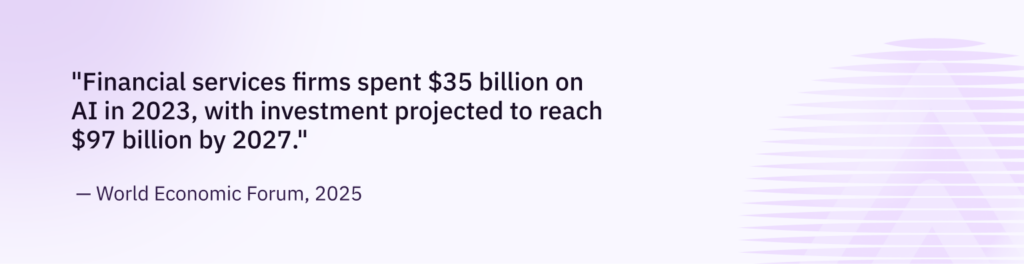
After more than $35 billion invested into fintech AI, the promise was clear: better targeting, smarter personalisation, faster growth. (World Economic Forum, 2025).
But the results have been underwhelming.
Here are 10 reasons why.
AI was never really built for optimisation in the first place. Most marketing systems are designed to convert attention into action, but this works a little differently for the wealth management industry. Allocations are built slowly, through research, conversations, internal debate, and repeated exposure to ideas. Decisions often take months and involve multiple stakeholders.
A recent report by ProFundCom on Why AI is Failing, highlights a growing disconnect. While firms are increasing their use of AI across marketing and distribution, many are seeing little improvement in lead quality, conversion rates, or asset flows.
What looks like a conversion is usually just the final step in a much longer process.
That same mismatch shows up in how data is used. AI depends on data, but in marketing the data is limited in ways that matter. Investor universes are small, systems are fragmented, and information becomes outdated quickly.
Models can detect patterns, but they often struggle to interpret what those patterns actually mean. And in this space, meaning is what drives decisions.
AI promises to make communication more relevant, but in practice it can feel off. Over-targeting can come across as intrusive, poor data leads to obvious mistakes, and messaging can still feel generic, even when it is technically personalised. Sometimes investors are simply shown more of what they have already seen, rather than what they actually need to see.
AI is very good at improving activity. Open rates go up. Clicks increase. Engagement improves.
But allocation decisions are not driven by activity, they are driven by conviction.
So while the numbers in dashboards improve, the outcomes often do not.
AI ends up optimising what is easy to measure rather than what actually matters.
Markets shift, preferences change, and decisions unfold over long timeframes. Many of the factors that influence allocation, such as relationships, timing, and internal dynamics, are not measurable at all.
AI can assign probabilities, but those probabilities are difficult to trust and even harder to validate, thus it is not always stable.
Generative AI has made content easier to produce, but not easier to stand behind. AI-generated material often lacks nuance, introduces risk, and requires heavy compliance review. In many cases, reviewing it takes as much effort as writing it properly.
In a trust-driven industry, that trade-off matters.
Moreover, AI operates within real constraints. Legacy systems, fragmented data, and strict compliance workflows limit how AI can be used in practice. Content cannot simply be generated and deployed in real time. It needs to be controlled, approved, and auditable.
Implementations take time, can cost $500,000 or more annually for mid-sized firms, often take 6 to 18 months to deploy, and may take several years to deliver meaningful returns.
At the same time, the budget is often pulled away from things that already work. Investment writing, thought leadership, and relationship-driven outreach are reduced.
Investors still look for clarity, judgment, and trust. Some are sceptical of AI-led communication. Others can recognise it immediately. Either way, they want to understand what they are investing in and why.
AI should be applied more selectively, with humans remaining responsible for meaning, narrative, and communication. Start small, focus on what delivers value quickly, and scale what proves useful.
AI has made wealth and asset management marketing more efficient.
But efficiency was never the real constraint.
The real challenge is the same. It’s not more reach, nor more activity, but turning investment thinking into something clear enough to act on and credible enough to trust.
That is where GoUpscale is focusing.
If you are looking to make your marketing more effective and engaging, while exploring how AI fits into your sales and distribution, our deep industry experience can offer you independent guidance and solutions grounded in what actually works, and what does not for your business.
GoUpscale is a technology and digital enablement company helping wealth and asset management firms scale efficiently and deliver superior digital experiences. Through AI-powered content creation, distribution, and engagement solutions, GoUpscale empowers businesses to grow more effectively in a digital-first world.
Learn more at https://goupscale.com/ or follow @GoUpscale on LinkedIn.

Dominic Gamble is a digital wealth expert and former private banker with 24+ years’ experience advising clients and building fintech platforms across Europe, the Middle East, and Asia.
Share on
Share on